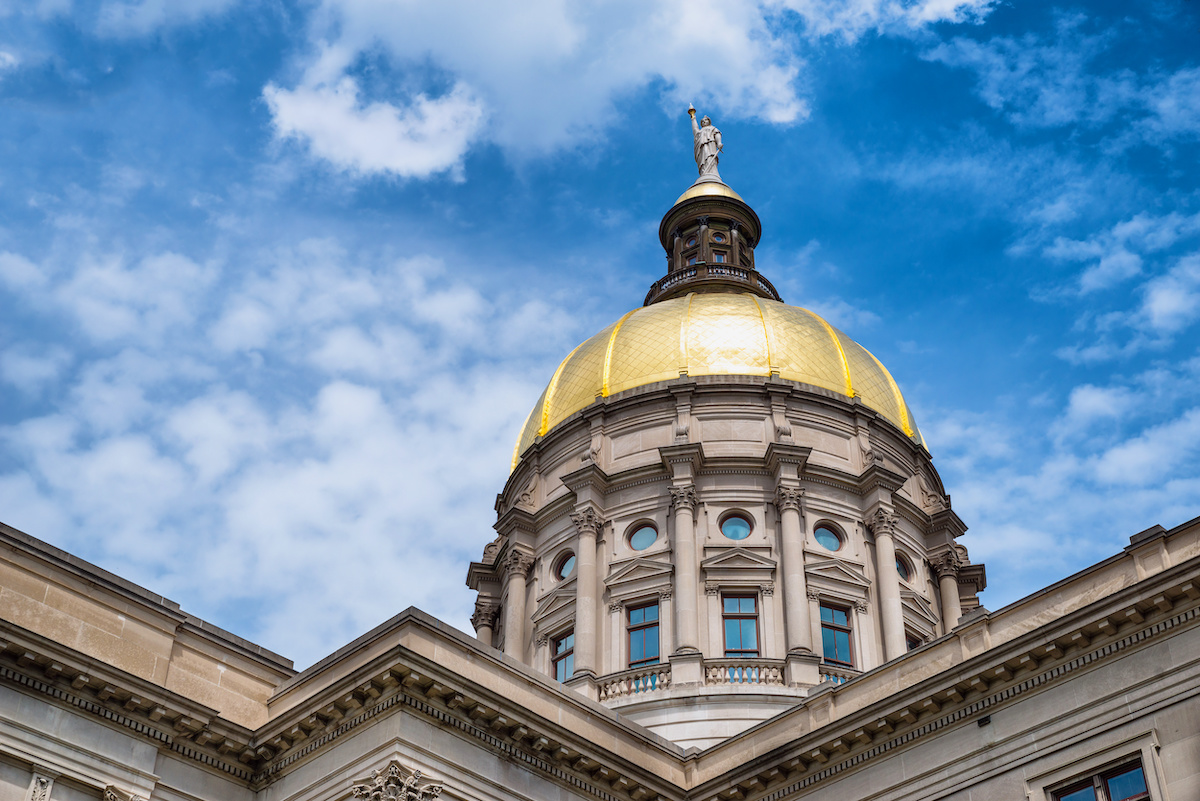
The Georgia General Assembly’s 2026 session began January 12, and is scheduled to adjourn April 6. The session unfolds as Governor Brian Kemp enters his final legislative session and multiple lawmakers campaign for 2026 statewide races, adding election-year pressure to the calendar and agenda.
Under the leadership of Lieutenant Governor Burt Jones, House Speaker Jon Burns, and Governor Kemp, lawmakers will return for the second year of Georgia’s biennial legislative session, so any bills that did not pass in 2025 can remain alive for 2026 consideration. Notably, Georgia no longer allows pre-filed bills, so bills carried over from 2025 will drive much of the initial policy agenda.
Below is an overview of key policy proposals that lawmakers will likely consider during the 2026 session.
Budget
Georgia uses a two-budget system where an “amended” budget is passed to adjust spending during the last quarter of the fiscal year to ensure a balanced budget.
The FY 2026 budget was set at $37.7 billion. Georgia reached the midpoint of its FY 2026 budget on December 31, 2025. The state has an excess of $14.6 billion remaining in the bank. Of that amount, $5.6 billion is a legislatively designated set-aside (rainy-day fund) to be used only in the case of specific revenue shortfall amounts. The remaining roughly $9.1 billion is classified as undesignated reserves.
The FY 2027 budget is currently in the early stages of preparation by the executive and legislative branches.
- State agencies were instructed to maintain the current FY 2026 budget levels for FY 2027. Those agency requests were submitted to the Governor’s Office of Planning and Budget (OPB) right around Labor Day. Governor Kemp will present his budget recommendations to the General Assembly during the first week of session in January.
Medicaid and Coverage
Healthcare debates are expected to span coverage, affordability, and workforce, especially for rural providers.
Georgia Senate Minority Leader Harold Jones and Democrats are signaling they will revive SB 192, the Georgia Health Insurance Affordability and Consumer Protection Act, which didn’t make it out of the 2025 session. The bill is aimed at lowering premiums. Republicans are urging the state to stay the course with Georgia Pathways to Coverage rather than pursuing further expansion.
Additionally, SB 50, PeachCare Plus, is viable to carry over into the 2026 session. It would broaden health coverage using federal dollars and Marketplace-style coverage mechanics.
Rural Health Transformation Program
The Rural Health Transformation Program (RHTP), a new program created under the One Big Beautiful Bill Act (OBBBA), will award $50 billion in state grants between 2026 and 2030. The program is designed to support rural healthcare access, workforce capacity, technology modernization, and infrastructure investment.
Georgia Department of Community Health (DCH) submitted the state’s application in November 2025, and CMS announced first-year grant awards for all 50 states under the Rural Health Transformation Program. Georgia is to receive $218.8 million for the remainder of federal fiscal year 2026. We expect to learn more from DCH on its implementation plans.
Georgia’s proposed RHTP initiatives focus on strengthening rural health systems through several key efforts:
- Transforming for a Sustainable Health System: Preparing rural healthcare facilities and providers to qualify for the Achieving Healthcare Efficiency through Accountable Design (AHEAD) Model for hospitals and AHEAD primary care programs from CMS to align with Georgia’s vision of rural progress.
- Strengthening the Continuum of Care: Address rural-specific health concerns through readiness assessments, gap analyses, technical assistance, and fiscal-risk mitigation.
- Connecting to Care to Improve Healthcare Access: Increase access in rural areas to ensure opportunities for preventive, primary, specialty, dental, and behavioral healthcare.
- Growing a Highly Skilled Healthcare Workforce: Increase and incentivize healthcare workers to practice in rural Georgia through expanded scholarship and GME programs and establishing rural recruitment incentives.
- Leveraging Technology for Healthcare Innovation: Improve care delivery and advance rural progress through technological advances in cybersecurity, robotics, electronic medical records, artificial intelligence, and more.
Taxes and Affordability
Georgia’s 2026 session is likely to feature a two-track tax debate: property tax relief and further movement toward a “path to zero” state income tax. Speaker Jon Burns has framed property tax cuts as a House priority heading into 2026.
HB 581, the Floating Local Option Sales Tax (FLOST), is being tested as a sales tax alternative to create property tax relief. Early results have been mixed. Some counties rejected the measure, and a large number of cities and school systems have opted out, citing revenue concerns.
Momentum is also building to reduce or eliminate the state income tax. Lt. Governor Jones created the Georgia Senate Special Committee on Eliminating Georgia’s Income Tax, elevating the issue heading into the 2026 election cycle. Key aspects of the proposed legislation recommended by the special Senate committee include:
- Goal: gradually reduce personal income tax to zero in 2032.
- Income Exemption: Starting in 2027, the plan would exempt the first $50,000 of income for single filers and the first $100,000 for joint filers from state income tax. This would mean about two-thirds of working Georgians would not pay state income taxes at all.
- Trigger Mechanisms: The final elimination of the tax would be contingent on specific revenue targets being met annually.
Insurance Reform
Governor Kemp made tort reform a top priority in 2025, advancing legislation promoted as a way to stabilize insurance costs. In 2025, Georgia enacted major pieces of that package, including SB 68, a broad tort and civil procedure package. SB 69 also passed. It is a litigation funding bill that requires third-party funders to register with the state, restricts foreign government involvement, and increases transparency and limits in civil cases.
The House convened a committee to study insurance rates, with the Insurance Commissioner testifying, an indicator lawmakers may pursue additional reforms in 2026 beyond the 2025 tort package.
Artificial Intelligence
A Senate study committee focused on social media and AI’s impact on children is preparing bipartisan legislation tied to technology use in schools. The committee will make formal recommendations for state action and partner with parents, policy experts, and representatives from state agencies and private organizations to determine how online protections could be improved and strengthened.
Likely to be reconsidered during the 2026 session is SB 9, which would outlaw certain political deepfakes with disclaimer and intent elements.